
AI Search Optimization: How Brands Earn Visibility in Answer Engines
A practical AI search optimization guide for brands that want to earn visibility in answer engines, AI summaries, and high-intent discovery journeys.
SearchAligned Team
SearchAligned Editorial Team
Introduction
AI search optimization is the practice of making brand, product, and expertise signals clear enough for answer engines to understand, retrieve, summarize, and cite. It does not replace classic SEO. It extends it. Search systems still need crawlable pages, useful information, trusted sources, and strong user experiences, but AI interfaces change how people evaluate answers and compare options.
Brands that win in answer engines tend to publish specific, well-structured, evidence-backed content. They explain who they serve, what they do, how their process works, what tradeoffs buyers should consider, and why the information can be trusted. SearchAligned approaches AI visibility through entity clarity, content marketing, technical SEO, and authority building rather than generic prompt-driven articles.
Table of Contents
- How AI search changes discovery
- Entity clarity and source trust
- Answer-first content structure
- Original evidence and comparison content
- Technical requirements for AI visibility
- Measurement, governance, and FAQs
How AI search changes discovery
Traditional search asks users to scan a results page, choose a promising result, and evaluate the page themselves. AI search often summarizes multiple sources before the click. That means the first impression may come from a generated answer, a cited passage, a comparison, or a follow-up question. Brands need content that can be understood at the passage level while still being valuable as a full page.
Users expect synthesized answers
This shift makes clarity more important. If a page hides the answer behind vague positioning, unsupported claims, or bloated introductions, it becomes harder for answer systems to extract useful information. A strong page states the answer, explains the reasoning, and supports the claim with examples, definitions, data, or process details.
The opportunity is not only to rank. It is to become a preferred source when buyers ask complex questions: which SEO partner fits our business, how should we structure a migration, what should an app development roadmap include, or how do we compare content investment against paid media?
Build entity clarity around the brand
AI systems rely on entity understanding. A brand should make its name, services, locations if relevant, expertise, authors, contact information, and topical relationships consistent across the website and broader web. Inconsistent descriptions make it harder for systems to connect the brand with the right services and buyer problems.
Ambiguity weakens retrieval
Start with the basics: organization schema, consistent naming, clear service pages, author or team signals, and a logical about page. SearchAligned’s About, Services, and Process pages support this by explaining what the company does, how work is delivered, and where readers can go next.
Entity clarity also applies inside articles. Define terms before using them heavily, name the audience, explain the scenario, and connect the topic to adjacent concepts. A page about AI search should naturally reference structured data, information gain, topical authority, digital PR, technical SEO, and content operations because those ideas shape the same decision.
Write answer-first sections
Answer engines often retrieve chunks of content rather than judging only the page as a whole. Each section should therefore answer a real question with enough context to stand alone. A strong section opens with the core point, then expands with rationale, examples, and next steps. This structure helps both users and machines.
Lead with the useful point
Use descriptive H2 and H3 headings. Instead of writing vague headings such as “Important considerations,” write headings like “Build entity clarity around the brand” or “Use comparison pages for commercial questions.” The heading should tell a reader what the section will teach before they read the paragraph.
This does not mean every paragraph should sound robotic or formulaic. Human-readable content still matters. The best answer-first writing feels direct, specific, and useful. It avoids filler, explains tradeoffs, and respects the reader’s time.
Publish original evidence instead of generic summaries
AI search makes generic content easier to ignore because many pages can say the same basic thing. Original evidence creates differentiation. Evidence can include a process, checklist, example, benchmark, case study, test result, expert explanation, pricing logic, implementation lesson, or a clear point of view drawn from real work.
Information gain separates useful pages
For an SEO agency, useful evidence might show how crawl waste was identified, how an internal linking model was redesigned, how content decay was reversed, or how a migration was protected. For development services, evidence might explain the tradeoff between a fast marketing site, a custom web app, and an ongoing maintenance model.
Google’s guidance on creating helpful, reliable content remains relevant in this environment. The helpful content documentation emphasizes people-first content, expertise, and usefulness, all of which also support answer-engine inclusion.
Use comparison content for commercial intent
Many AI search queries are comparative. Buyers ask which approach is better, what a service includes, how much effort is required, or what risks they should avoid. Brands that publish thoughtful comparison pages can shape those answers by explaining criteria rather than simply declaring themselves the best option.
Buyers ask AI systems to narrow choices
Comparison content should be fair and specific. Explain when technical SEO matters more than content expansion, when link building is appropriate, when a web app should be rebuilt, or when a lean maintenance plan is enough. This kind of content builds trust because it helps the reader make a better decision.
Avoid thin “versus” pages that repeat boilerplate and push every reader to the same conclusion. Answer engines are designed to satisfy nuanced questions. A page that names tradeoffs and decision criteria is more useful than one that only sells.
Structure pages for extraction and citation
Clear formatting helps answer systems identify definitions, steps, pros and cons, examples, and FAQs. Use concise paragraphs, lists where useful, descriptive headings, internal links, and schema markup. Avoid burying important points inside decorative layouts, image-only text, or interactive elements that are difficult to parse.
Formatting affects machine understanding
The page should also provide complete context. If a section says “our process,” it should name the steps. If it says “this improves rankings,” it should explain why. If it references a service, it should link to the relevant SearchAligned page so users and crawlers can follow the relationship.
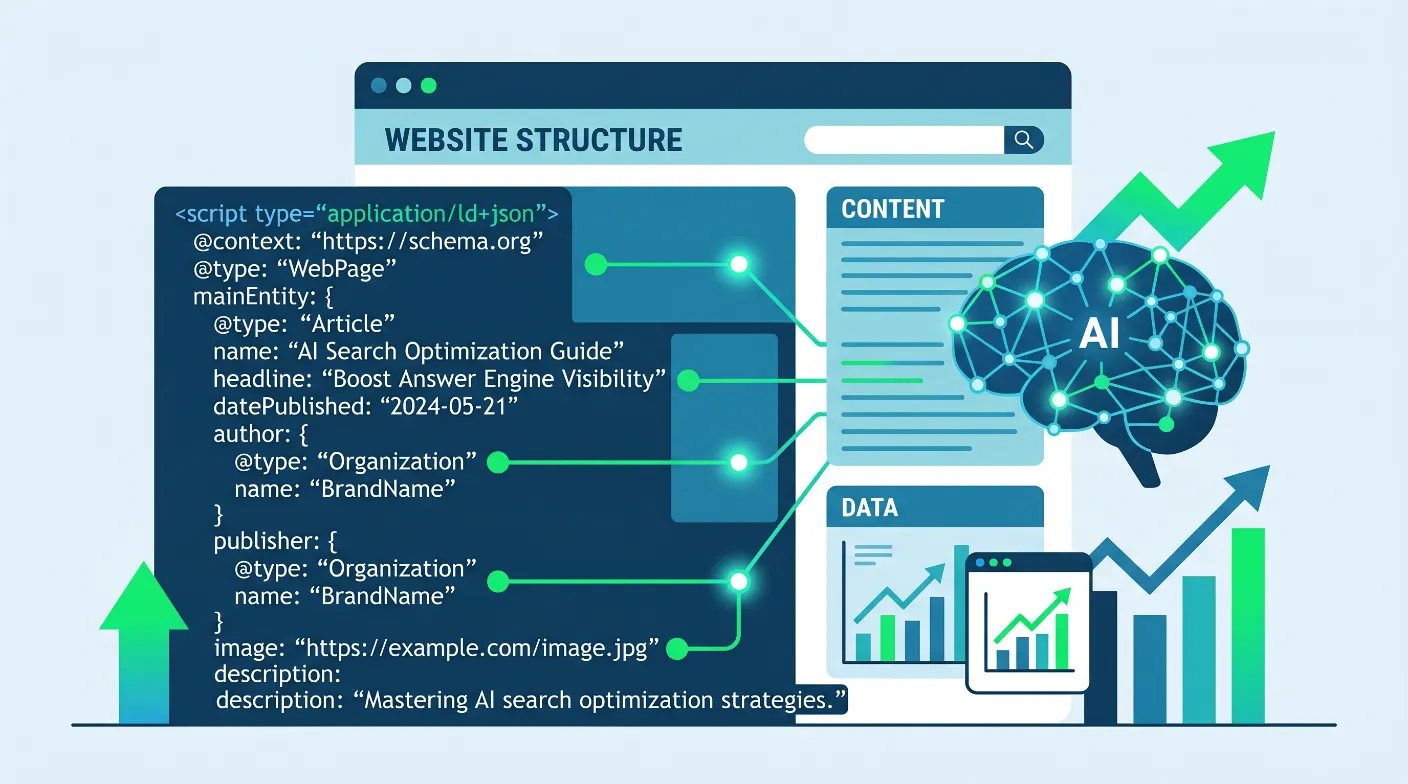
Structured data is not a magic visibility switch, but it reduces ambiguity. Organization, BreadcrumbList, BlogPosting, Service, and FAQ schema can help search engines understand page types and relationships when they accurately reflect visible content.
Keep classic SEO fundamentals in place
Answer engines cannot reliably use content they cannot access, understand, or trust. Technical SEO remains foundational: clean status codes, crawlable links, indexable pages, canonical URLs, fast loading, mobile-friendly templates, and stable metadata. AI optimization built on a weak technical base will be inconsistent.
AI visibility still depends on discoverable pages
This is why SearchAligned connects AI search work with technical SEO and content operations. A clear article is more valuable when it loads quickly, has a canonical URL, exposes the right structured data, and sits inside an internal linking system that reinforces topical authority.
Teams should test important pages in rendered HTML, not just in a visual browser. Confirm that the title, description, canonical, Open Graph tags, article content, internal links, image alt text, and schema are present for the page that search systems will process.
Design content clusters around buyer questions
AI search tends to reward coverage that answers connected questions. A single generic guide is rarely enough. Build clusters around the questions buyers ask before, during, and after a purchase decision. For SEO services, that may include audits, technical fixes, content calendars, digital PR, migration planning, pricing, timelines, and measurement.
Topic depth creates retrieval opportunities
Each page should have a distinct job. A service page can explain the offer. A blog post can teach a concept. A case study can prove the process. A comparison page can help decision-making. An FAQ can answer objections. Internal links should connect these assets so users can move from learning to evaluation without friction.
This approach supports semantic relevance without keyword stuffing. Primary keywords still matter, but secondary and related terms should appear because they are genuinely needed to explain the topic. Natural coverage is stronger than repetition.
Measure AI search visibility carefully
AI search reporting is still less mature than classic ranking and analytics reporting. Teams should avoid overclaiming precision. Useful indicators include branded query visibility, cited URLs, referral traffic from AI interfaces, changes in assisted conversions, impressions in Search Console, and qualitative tracking for priority questions.
Use directional signals, not false certainty
Create a list of questions that matter to buyers and review how different search experiences answer them. Track whether your brand is mentioned, whether your pages are cited, whether competitors are framed as authorities, and which content gaps appear repeatedly. This gives content teams practical direction even when tools disagree.
Measurement should lead to improvements: clearer definitions, stronger examples, better schema, improved internal links, updated service pages, or new comparison content. The point is not to chase every AI feature. The point is to become a more useful and trustworthy source.
Create governance for AI-era content
AI tools can help with research organization, outlines, and production workflows, but brands should not publish generic AI-generated filler. Content needs expert review, factual checking, brand context, and a clear purpose. Readers can recognize empty articles, and answer systems have less reason to cite them.
Human review protects trust
Set standards for originality, sourcing, internal linking, grammar, accessibility, and update frequency. Decide who approves claims, who checks service accuracy, and who owns refreshes when search behavior changes. This governance matters more as teams publish at scale.
A useful AI search program is not a content volume race. It is a quality system that makes expertise easier to find, understand, and trust across classic search, AI answers, social discovery, and direct buyer research.
Refresh content as answer behavior changes
AI search optimization is not a one-time publication task because answer formats, cited sources, and buyer questions change. Review priority articles every quarter and update definitions, examples, screenshots, service references, and external citations when the market shifts. A stale article can lose usefulness even when the URL still ranks in classic search results.
Use updates to improve precision
Refreshes should make the page more precise, not merely newer. Add clearer decision criteria, remove claims that no longer match the service, expand thin sections where buyers need more detail, and link to newer internal resources. This habit protects trust and gives answer systems fresher, better-structured source material to evaluate.
Update notes should be visible to readers when the change materially affects advice. A short refresh discipline gives sales, marketing, and leadership teams confidence that published guidance still reflects current buyer behavior and current SearchAligned delivery standards.
Conclusion
AI search optimization rewards the same qualities that good buyers value: clarity, specificity, evidence, trust, and useful structure. Brands should not abandon classic SEO. They should strengthen it with entity clarity, answer-first writing, original evidence, comparison content, schema, and internal links that help both users and search systems understand expertise.
The most durable strategy is to become a genuinely useful source. For teams that need a practical roadmap, SearchAligned can connect content strategy, technical SEO, and authority building into a program designed for both traditional rankings and answer-engine visibility.
Frequently Asked Questions
Is AI search optimization different from SEO?
It is an extension of SEO. Classic crawlability, content quality, authority, and user experience still matter, but AI search adds more emphasis on entity clarity, passage-level answers, original evidence, and citation-worthy structure.
Can AI-generated articles rank or appear in answers?
Low-effort generated articles are risky because they often lack originality, expertise, and useful detail. AI can support workflows, but publishable content should be human-reviewed, fact-checked, and differentiated by real experience.
What content works best for answer engines?
Definitions, checklists, comparisons, process explanations, case studies, FAQs, and evidence-backed guides tend to work well because they answer specific questions and provide context that can be summarized accurately.
How should brands track AI visibility?
Track priority buyer questions, cited URLs, brand mentions, referral traffic from AI interfaces, Search Console trends, and qualitative competitor comparisons. Treat the data as directional and use it to improve content.